
Pleasants County Property Tax Record Fields
In Pleasants County, a property tax record is really two documents. The Assessor's card carries the parcel detail: land, buildings, class, and appraised value. The Sheriff's tax inquiry carries the money side of the account. It shows what was billed and what is due. Which one you open first depends on the question. If it concerns payment status, go to the account. If it concerns valuation, go to the assessment. Both rely on similar parcel keys, yet each exists for its own job.
| Tax or assessment field | What it tells you | Where to confirm |
|---|---|---|
| Year / Type / Ticket | Tax year and account category | Sheriff Tax Inquiry |
| Total Billed / Total Paid | Charges and payments posted to the account | Sheriff/Tax Office |
| First Half / Second Half / Total Due | Installment and remaining balance fields | Sheriff account or receipt |
| Account No. / Map-Parcel | Tax-account and map reference | Compare with assessment PID |
| Land / Building / Total Appraisal | Assessment components, not tax paid | County Assessor card |
| Billing Address / Description | Mailing contact and account description | Sheriff account and deed |
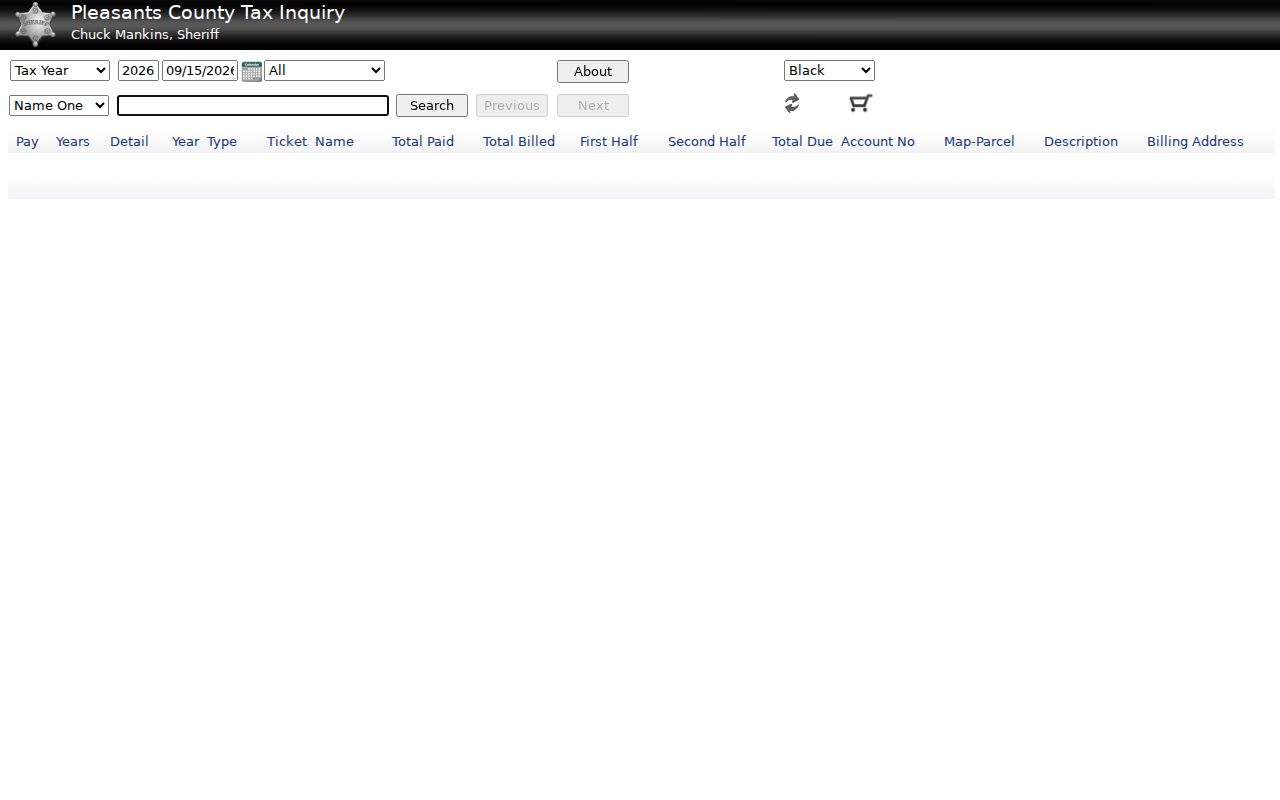
The Pleasants County Sheriff tax inquiry displays these billing and payment headings.
Payment detail lives in the Sheriff's inquiry. For parcel and valuation context, the Assessor card is the better stop.
Look Up a Pleasants County Property Tax Record
Search with the account number or the Map-Parcel from a bill whenever you can. The Sheriff's property search also offers Year, Type, Ticket, Name, Description, and Billing Address fields. It shows figures for Total Paid, Total Billed, First Half, Second Half, and Total Due. Note the year you selected before comparing results. Amounts shift from year to year. The account label may not match the full PID format used in the state assessment viewer.
When an account will not appear, try the owner's name or map-parcel key. Then check it against the Assessor card. A missing online result does not mean a zero balance. Call the Sheriff/Tax Office at 304-684-2285 with the account, map-parcel, and year ready. The office sits at 305 Barkwill Street in St. Marys. It posts weekday hours of 8:00 a.m. to 4:00 p.m.
The Assessor's link hub also ties property resources together. It points to Tax Inquiry, the County Clerk's document index, MapWV, the state Tax Department, and WVGenWeb. Carry the same parcel key across those portals. Do this when moving between the property search and any deed records lookup.
Payment Dates for Pleasants County Property Tax Records
Pleasants County publishes firm dates for real property tax billing. Statements go out July 15. September 1 is the first half deadline, with any discount. March 1 is the second half deadline. After April 1, the county will not accept split payments. Taxes turn delinquent May 1. These dates anchor the calendar. Still, a current bill and the Sheriff control the actual balance on any parcel.
The tax-lien sale runs each year between October 15 and November 22. Confirm the exact sale date and its publication with the Sheriff/Tax Office that year. Redemption questions go to the West Virginia State Auditor at 304-558-2261. A delinquent listing or tax-sale notice alone proves nothing about clear title. Review the tax deed, later conveyances, redemption status, and any other liens.
Personal property runs on its own track. The county's estimate-tax page bases statements on what the taxpayer owned on July 1 of the prior year. It also uses where the taxpayer lived on that date. Unpaid accounts are published delinquent after April 30, with publication fees and interest added. Keep that timing separate from a real-estate parcel's assessed value.
Assessment Base for Pleasants County Property Tax Records
Ordinary real estate in Pleasants County is assessed at 60% of current market value, according to the Assessor. The Assessor uses cost, market, and income methods. The West Virginia Tax Division describes the same general 60% rule. That figure is an assessment level, not a tax rate. Levies from the school board, the County Commission, Belmont or St. Marys, the state, and special districts all shape the final tax bill.
The Assessor's value page also describes the annual real estate book. It also covers property visits at least once every three years. Assessment work is to be complete by January 30. Books then go to the County Commission by February 1. That is for the Board of Review and Equalization. A deed recorded after the annual book process may lag on the public card. The county publishes no typical owner-roll delay. Always read the deed date alongside the card's tax year.
The Pleasants County Assessor value and appeal page lays out local assessment duties. It also lays out the review steps.

Pair that county explanation with the Sheriff account, since assessed value and tax due are separate figures.
Separate Value and Tax in Pleasants County Property Tax Records
An assessment card in Pleasants County looks like a bill, but it is not one. The land appraisal, building appraisal, yard improvements, commercial value, and total appraisal are value fields. They show neither a sale price nor a tax receipt. One Pleasants County sample card carries an X-Exempt classification and land use 604. It shows zero living area and no other improvement values. Read class and use first. Only then compare that parcel with a house.
The statewide Ad Valorem rule sets the base. Assessed value generally equals 60% of fair market value. A state ratio study weighs appraisal levels against sales. But it cannot turn one assessment into a current appraisal or prove a trend in your neighborhood. The County Assessor values most ordinary property. Natural-resource real property and industrial real and personal property belong to the Tax Commissioner. The Board of Public Works handles public-service business operating property. Check exemptions and class with the Assessor before estimating a bill. Then let the Sheriff confirm the tax amount. The West Virginia Ad Valorem assessment explanation spells out the state standard for Pleasants County property tax records.

The state rule only sets the assessment base. Local levy rates and the account entries underneath them determine the bill the Sheriff shows for a Pleasants County parcel.
Review a Pleasants Assessment
A taxpayer who disagrees with an assessment has two paths. Ask the County Commission to review the value. The Commission sits as the Board of Review and Equalization. Or appeal to the West Virginia Board of Tax Appeals in Charleston. The county requires the state appeal before the County Commission adjourns its hearings. Those are the Board of Equalization and Review hearings. The Assessor, or a representative, may appear to defend the county's value.
Timing is the trap here. The county page publishes no current Pleasants appeal dates and no local form. Never rely on a remembered date. Ask the Assessor or County Commission for the current assessment-year notice. Ask also for the form, the meeting schedule, and the evidence requirements. Bring the parcel ID. Bring the card's class and value breakdown, the tax year, and the facts supporting a correction.
Keep two questions separate. A valuation dispute belongs with the assessment review process. A payment, credit, delinquency, or receipt question belongs with the Sheriff/Tax Office. Pleasants County uses both records. The name or address field on one may not match the other.
Delinquent Pleasants County Land
A delinquent flag on a map panel is only a lead. For billed, paid, and due account fields, the Sheriff Tax Inquiry is the source. Search by tax year, account, name, and map-parcel. Then move to the County Clerk IDX. It indexes Delinquent Land and Tax Deed entries. It also indexes WV Tax Lien, IRS Tax Lien, judgment, release, and trustee-sale entries. A tax account and a recorded lien are separate records.
A sale or enforcement question needs one more stop. Add the Circuit Clerk's foreclosure or tax-enforcement file to the search. A court case, a tax-sale publication, a lien entry, a redemption, and a later deed are different stages of one history. The county directs redemptions to the State Auditor. Check that status before treating a sale notice as final proof of ownership. The annual sale date falls within the October 15 to November 22 window each year. Confirm the exact date with the county. Do that before acting on a Pleasants County property records finding.
Mineral and Industrial Assessments
Pleasants County assessment books list mineral owners alongside surface owners. Natural-resource and managed-timberland values follow West Virginia Tax Department rules. The state also values industrial real and personal property. A surface owner, a mineral interest holder, and an industrial operator can appear under different names. Some appear under different parcel references. A surface deed may not describe every mineral right.
For a mineral property tax question, write down the mineral ID, district, map, parcel, suffix, and deed language. Search the County Clerk index for leases, assignments, trust instruments, easements, and releases. Ask the Assessor which office valued the account. Then take the bill question to the Sheriff. Land records, valuation records, and tax records hand off to one another in Pleasants County. No single document combines them.
Request Pleasants County Property Tax Records
Online access is only one route to Pleasants County property tax records. The Assessor lists scanned map cards and land books. The office can answer for a parcel's assessment year, card, and appeal calendar. The Sheriff can check a payment or delinquency account. The County Clerk holds deeds and recorded liens that explain parcel changes. For anything not online, West Virginia Code §29B-1-3 allows a request to the custodian for inspection or copying. Statutory exceptions apply.
Name the exact account or PID, the year, and the record you need. Ask about the file format and a copy estimate. No universal county fee or response deadline is published. A tax statement can be mailed on July 15. A map or assessment card may carry a different update date. Write down the date printed on every record. Dates anchor each Pleasants County document to its moment.
Keep two records together. Use the Assessor for assessed value and parcel facts, and the Sheriff for what was billed, paid, or due.