
Pleasants County Property Value Types
Three numbers dominate a Pleasants County property value page. Assessed value, market value, and sale price are not interchangeable. The Assessor records appraisal fields for taxation. Market value serves as the standard inside the state's assessment framework. A sale price belongs to a transaction. It may show up in a deed or related sales paperwork. Dates, purposes, and sources differ. That is why the three figures rarely match on the same parcel.
| Value type | Meaning | Where to look |
|---|---|---|
| Assessed value | County or state appraisal used in the property-tax system | MapWV assessment detail and Assessor books |
| Fair market value | Value standard used for the general 60% assessment level | State assessment rule and valuation method |
| Recorded sale consideration | Amount or transaction data associated with a transfer | Deed and state sales-listing form; public display is not verified |
| Tax bill | Amount charged after applicable levies and account entries | Sheriff Tax Inquiry, not the appraisal field |
The total appraisal is not a sale price. Neither is a tax bill a market appraisal, so check any Pleasants County value against the record's year and parcel identity first.
Read Pleasants County Property Value Detail
An assessment card has layers. Land Appraisal, Building Appraisal, Other Bldg/Yard Values, Commercial Value, and Total Appraisal each get their own line. Class, land use, acreage, building area, replacement cost, and adjustment fields may appear as well. Keep the components. A shift in land or building treatment often explains why two totals differ, and the sample Pleasants County MapWV assessment detail shows that field structure.
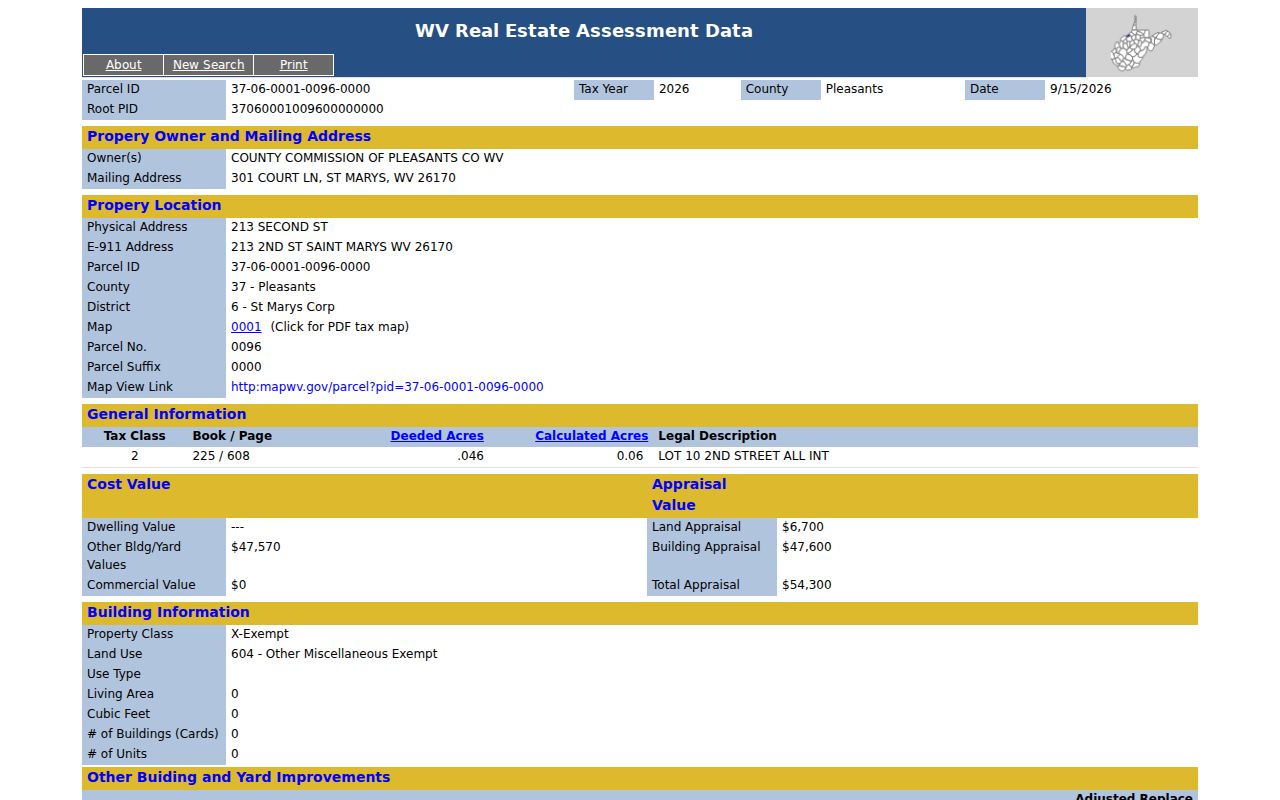
This example is County Commission property. Its class is X-Exempt with land use 604, so it is not a normal home-value illustration.
Use the Pleasants County Property Value Assessment Level
The math behind the ratio is simple. The Pleasants County Assessor assesses real estate at 60% of current market value. It uses cost, market, and/or income approaches. The state Tax Division states the same statutory 60% standard. A $100,000 market-value basis corresponds to $60,000 in assessed value. That arithmetic explains the ratio only. It does not give a current market estimate for any parcel. The West Virginia Ad Valorem page describes the assessment relationship in full.

The state rule gives context for the assessed number, but class, method, year, and levies still shape the final figure.
Look Up a Pleasants County Property Value
Start with MapWV and search by address or parcel. Open the assessment report and note the Tax Year and page date. The sample PID 37-06-0001-0096-0000 identifies county 37, St. Marys district 06, map 0001, parcel 0096, suffix 0000. Use that key when asking the Assessor about a card or comparing two years. Some results show no building value or a special class. Read the fields first. An entry without building value is not an ordinary residence. The Pleasants Assessor lists scanned map-card files, scanned land books, and county tax maps. If the public viewer lacks a needed year or detail, call 304-684-3132 and ask which assessment record exists for that parcel. The county publishes no neighborhood price series. A single card cannot establish a countywide trend.
- Assessed value
- The amount in the assessment record used in the tax system.
- Market value
- The fair-market standard referenced by the state's assessment rule.
- Assessment level
- The general 60% relationship between assessed and fair-market value.
- Sale consideration
- Transaction information linked to a conveyance, distinct from appraisal.
- Reassessment
- A change to a parcel's assessed record under county procedures.
Separate Sale Data from Pleasants County Property Values
West Virginia's STC 12:39 form gathers a lot. It records county, district, tax map and parcel, account, mineral ID, grantor, and grantee. New-owner mailing addresses appear too. So do tax-statement addresses, prior deed Book/Page, and source of title, which makes the form a strong clue to what the state collects around a transfer. Consideration is not a guaranteed portal field. Use the County Clerk deed index instead. Locate the transaction there. Ask the custodian for the full instrument or sales-listing record. A recorded amount rarely equals today's market value. The 2024 state appraisal-ratio study compares appraisal levels with sale prices for its analysis, but it cannot turn one past sale into a current appraisal for a Pleasants County parcel.
Understand the Pleasants County Property Value Cycle
Pleasants County reassesses on a public schedule. The Assessor visits real estate at least once every three years. Annual assessments wrap up by January 30. The books then go to the County Commission by February 1 for Board of Review and Equalization. Deeds and wills feed the yearly Real Estate Book. Tax maps get updates each year too. New parcels and recorded documents drive those revisions. The county states no typical lag between a closing and a card update.
The 2024 state ratio-study report uses a market-value date of July 1, 2023 for its tax-year analysis. That date frames the study alone. It does not date every current card, so check the tax year shown on the parcel detail and ask the Assessor which book cycle applies before comparing an old assessment with a recent sale.
Read Pleasants County Property Value Classes
Class and land use matter. One public sample card shows an X-Exempt class and land use 604, with no living area and no other improvement values. That card is not a normal occupied house, so it should not be compared with one. Check class, use code, exemption, and building detail first. Judge any low or high appraisal only after those checks, since class alone can explain the number.
The state splits valuation duty. County assessors value ordinary residential, commercial, and personal property. The Tax Commissioner values natural-resource real property along with industrial real and personal property. The Board of Public Works values public-service business operating property, and Pleasants assessment books also list mineral owners. A mineral, industrial, or exempt parcel may follow a different record trail than a surface residence.
The county's Assessor value and review page describes local valuation methods and appeal routes.

Use the county page to learn how the roll works and how its review runs. Then read your own parcel's year and class.
Compare Market Signals for Pleasants County Property Values
The same parcel can show three different numbers. A deed reports a transfer, and it may be paired with sales-listing data. An assessor card applies the county's valuation methods to a single tax year. A tax bill applies levies and account rules. Pleasants County names the school board, the County Commission, St. Marys and Belmont, the state, and special levies among its taxing bodies. The bill is not 60% of a price.
Gather the full picture first. For a fair comparison, collect the parcel's tax year, class, land value, building value, other improvements, total appraisal, sale date, and any recorded consideration source. Compare only after checking class, exemption, acreage, and district. Neither city publishes an official trend table. Do not infer that one city's homes rose or fell by a set percentage.
Check Pleasants County Mineral Property Values
Mineral and surface interests can sit under different deeds, leases, or assessment references. The split trips up many owners. The county Assessor's books carry mineral-owner listings, while the West Virginia Tax Department values natural-resource real property under state rules. Search the mineral ID in the County Clerk index. Search any lease or assignment there too. A surface parcel's total appraisal may not account for every mineral interest, and a mineral owner need not be the surface owner.
Industrial valuation also runs through the state Tax Division. Ask which public record supports the assessment. That matters when a parcel has an industrial operator, an oil or gas interest, or a special class. The Assessor card is the county roll result, and it may not be the sole source for state-valued property.
What Pleasants County Assessed Property Value Means
An assessed value exists to support taxation under the state's assessment framework. It is not an appraisal. It is not a guaranteed sale price or a current offer. The Pleasants County card reflects its tax year, property class, exemption, valuation method, and annual book cycle. For the amount due, use the Sheriff account. For an assessment concern, ask about the Board of Review and Equalization or the state Board of Tax Appeals process.
The Assessor publishes no current appeal calendar or form. Ask for the assessment-year notice before acting. West Virginia Code §29B-1-3 lets you request a public assessment record from its custodian, subject to exceptions, though it does not certify a value. A professional appraisal remains a separate service.
Value limit. A Pleasants County assessed value is a tax record, not what the parcel would necessarily sell for and not a substitute for an appraisal.